The SCHUFA Risk and Credit Compass examines trends in borrowing, credit obligations, and payment behavior. The analyses are based on the SCHUFA database and highlight current trends and developments.

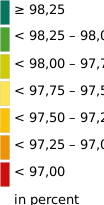
On our interactive map, you'll find information on consumer payment defaults in Germany for all districts and federal states. Results on other topics can be found in the study.

Debt & Payment Delays: A Regional Comparison—Analysis of the Year 2025

Anteil der mindestens 18-jährigen Personen, zu denen der SCHUFA mindestens eine Negativinformation vorliegt.

Anteil der mindestens 18-jährigen Personen, zu denen der SCHUFA ausschließlich von Vertragspartnern gemeldete Negativinformationen vorliegen.

Anteil der mindestens 18-jährigen Personen, zu denen der SCHUFA mindestens eine öffentliche Negativinformation aus einem amtlichen Verzeichnis vorliegt.
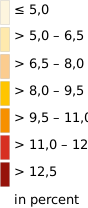
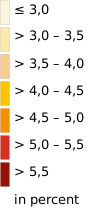
Legende
Legende
Leaflet | © GeoBasis-DE / BKG 2020 | SCHUFA Holding AG.

Economic development does not manifest itself the same way everywhere. This also applies to payment difficulties. The data reveal just how varied consumers’ financial situations are from region to region.

  • Deutschlandtrend: In 2025, SCHUFA had records of payment defaults for 8.1 percent of the adult population. In the previous year, this percentage was 7.9 percent.
  • Regional Differences: The proportion of people with payment difficulties varies, in some cases significantly, from region to region. These results often reflect local economic and structural conditions. Cities with a history of heavy industry and economically disadvantaged regions contrast with prosperous municipalities and their surrounding areas.
  • Federal states: In 2025, Bavaria (6.0 percent), Baden-Württemberg (6.6 percent), and Brandenburg (7.0 percent) recorded the lowest proportions of people with payment difficulties. The highest rates were in Bremen (11.2 percent) and Berlin (10.1 percent). Among the larger states, North Rhine-Westphalia had the highest rate at 9.9 percent.
  • Counties and independent cities: At the county level, the range extends from 3.6 percent in Eichstätt County to 19.9 percent in Duisburg. The highest proportions of consumers with payment difficulties are found primarily in cities not belonging to any district in the Ruhr region, in the Palatinate, and in Bremerhaven, Wilhelmshaven, and Neumünster in the far north.
  • Important Note: The analyses describe regional differences in the distribution of payment defaults. They show the respective percentage in each region. Regional characteristics or places of residence are not used to assess individuals’ creditworthiness.

In August 2026, the number of people with new payment defaults was lower than in the same period of 2025.

New Payment Issues

The number of new loan agreements in August 2026 is lower than in the same period last year.

New Loan Agreements

As of December 2025, SCHUFA had recorded at least one negative entry for 8.2 percent of business owners, self-employed individuals, and registered merchants in Germany. This means that the so-called “negative rate” for businesses in the new year is slightly higher than the previous year’s figure.

Negative rate

The volume of corporate loan applications declined across all industries in December 2025.
However, demand for credit is higher than it was in 2024.
The industries are defined in accordance with the 2008 Classification of Economic Activities (WZ 2008) of the Federal Statistical Office.

Business Inquiries